
DEVAP Air Conditioner
NREL is paving the way for the next evolution of A/C technology. With a huge opportunity for sustainability, efficiency, and financial improvements in air conditioning, NREL partnered with Synapse to design and build a prototype that proved a theoretical model in the real world. The resulting design reduced energy consumption by up to 80% while improving comfort through independent temperature and humidity control.
Desiccant cooling
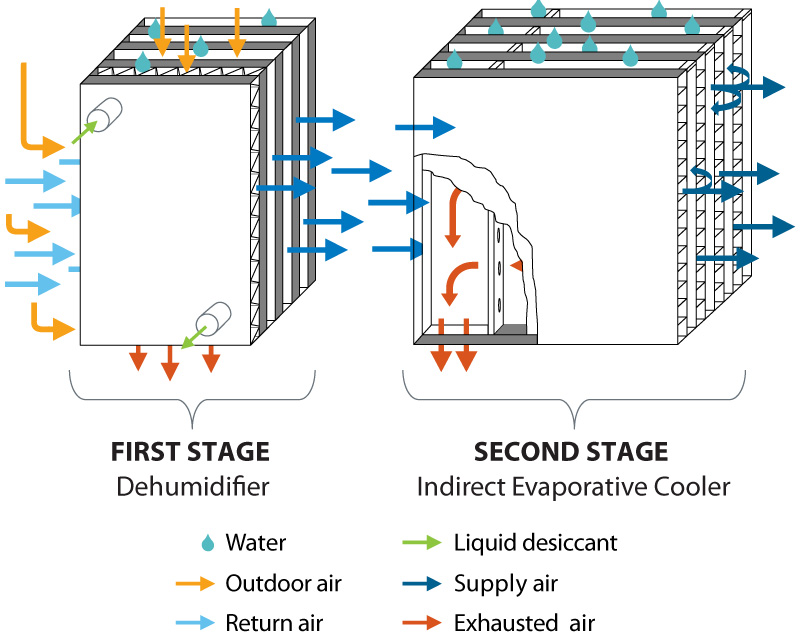
NREL’s concept uses desiccant materials which remove moisture from the air by using heat and advanced evaporative technologies. The result is a cooling unit that uses 90% less electricity and up to 80% less total energy than traditional air conditioning.
DEVAP replaces the refrigeration cycle with a thermally activated absorption cycle and is capable of being powered by natural gas and solar energy. In addition to superior energy efficiency, the use of salt solutions means none of the harmful carbons associated with refrigerants are being released into the air. Furthermore, using far less electricity leads to a lower monthly energy cost.
Our work
Synapse built one of two prototypes of DEVAP based on NREL’s design and modeling, which were tested in NREL’s Advanced HVAC Systems Laboratory. Experiments validated the modeled predicted energy savings of 40% in humid climates and 85% in dry climates, empowering the model as a tool for developing marketable designs, and illustrating the potential of DEVAP to transform existing air conditioning technology.
Potential impact
Given that air conditioners use more electricity than any other home appliance, widespread use of the highly efficient DEVAP technology could result in significant operating and utility cost savings. In addition to energy savings, DEVAP operates with a concentrated salt water solution instead of using refrigerants such as environmentally harmful hydrofluorocarbons. Furthermore, compared to vapor compression air conditioners, DEVAP’s novel design improves air quality by independently controlling temperature and humidity and increasing ventilation.
Future development
The future looks bright for DEVAP and Synapse looks forward to continuing work with NREL towards a commercially viable product and market launch.
Challenges remain in developing methods to produce the DEVAP system at scale. The novel design of the air desiccation system and indirect evaporative cooling systems require iteration and optimization to produce it at a price point that is competitive with conventional systems.


